

Why act now
Background to net-zero
First conceived in 2005 by physicists David Frame and Myles Allen, the net-zero concept of cutting human-caused carbon dioxide emissions such that any remaining CO2 emissions were balanced by removals from the atmosphere, was finally incorporated into the Paris Climate Agreement 10 years later. It was considered that a net-zero balance of emissions and removals would stabilise global temperatures. With research uncovering the dangers of surpassing 1.5°C, it was calculated that a mid-century target for achieving net-zero would be required to keep below 1.5°C. A target date of 2050 was set at Paris - just 35 years for humanity to change its ways. An achievable challenge if everyone was on board.
Many governments around the world came under intense pressure to set net-zero goals. Hundreds did so, along with thousands of companies and financial institutions, which saw the economic opportunities of a transition to clean energy.
Although this shift to a net-zero target led to some dubious pledges that rely far too heavily on using forests and other natural carbon sinks to soak up human-caused CO2 emissions, it has changed the trajectory for this century. Around three quarters of global CO2 emissions are now covered by a net-zero pledge, and projections for warming have fallen from around 3.7°C-4.8°C before the Paris agreement, to 2.4°C-2.6°C under current climate promises.
Not enough
The following is the introduction to an article which appeared in Nature Climate Change in March 2026. The full article "The hard road back from overshoot" can be found at https://doi.org/10.1038/s41558-026-02573-5.
"There is a point at which ambition becomes memory. The 1.5°C world was once a promise to the future. It is a promise written into treaties, argued in court, affirmed in court rulings, folded into national policies and business plans, and repeated in classrooms around the world. Scientists now speak of overshoot, a term suggesting that the internationally set and agreed upon line will be crossed, and management of overshoot will try to find the way back, as if recovery were a kind of faith. Surpassing this temperature threshold and then returning to it, known as climate overshoot among the science community, describes a period when the planet warms beyond the agreed limit before cooling again. The Paris Agreement was designed to avoid it. But emissions have kept climbing, even the most optimistic models now project that the global temperature will rise past 1.5°C in just a few years, reach 2°C in the next decade, and will remain above that for decades before coming back down, perhaps. The new debate is no longer about prevention but how to recover from what has already been set into motion."
Rising Costs
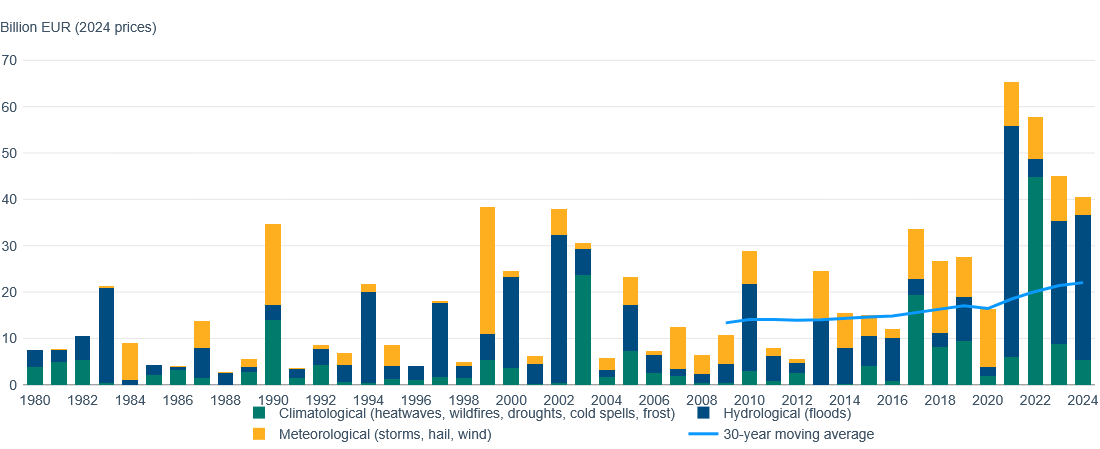
From the Stern Report (2006) to more recent reports from organisations such as the World Economic Forum and the UK Climate Change Committee, estimates of future annual economic losses run into the trillions. The graph below illustrates the direction of travel for EU Member States.
Annual economic losses caused by weather-related and climate-related extreme events in the EU Member States